Additional Menu
Peer Review Process
Table of Content
Peer Review Process
Final Preparation for Publication
Editorial Workflow
Peer Review Process
Manuscript Submission All manuscripts must be submitted via the online system at [PCSP Submission System URL/Link]. The Editorial Office will conduct an initial review for format compliance, scope, and plagiarism check (using Crossref Similarity Check). Manuscripts not following instructions will be returned. Authors are obligated to inform if the manuscript is a potential duplicate. Questions can be addressed to [Official PCSP Email].
Peer Review Process Primary Care Science and Practice (PCSP) implements a double-blind peer review process for all submitted manuscripts. This policy ensures that author and reviewer identities are kept confidential from each other during the entire evaluation process to guarantee objectivity. The peer review process flow is as follows:
- Initial Selection (Editorial Screening): All submitted manuscripts will first undergo initial selection by the Editor. At this stage, the Editor assesses manuscript compliance with the journal scope, adherence to formatting and writing instructions, as well as basic originality and significance. Manuscripts deemed unsuitable or not meeting minimum quality standards may be directly rejected (desk-rejected) without being sent to external reviewers.
- Expert Review: Manuscripts passing initial selection will proceed to the expert review stage. The manuscript will be sent to at least two (2) independent expert reviewers with expertise in the relevant field. Reviewers are asked to provide in-depth evaluation regarding scientific quality, methodology, originality, validity of findings, and the manuscript's contribution to primary care science and practice.
- Duration and Decision: PCSP is committed to providing an efficient review process. The entire peer review process, from manuscript submission to final editorial decision, is estimated to take about 8–12 weeks.
- Final Decision: After reports from reviewers are received, the Editor will evaluate their recommendations and make the Final Decision. The decision can be: Accept, Minor Revision, Major Revision, or Reject. Full authority for this final decision rests with the Editor, and the decision is absolute.
Decisions and Manuscript Revision Based on reviewer recommendations, the Editor's decision can be "Accept", "Minor Revision", "Major Revision", or "Reject". Manuscripts receiving three consecutive "Major Revision" decisions will be rejected.
- Decision Conflict: If significant disagreement occurs between reviewers, the Editor-in-Chief will make the final editorial decision.
- Manuscript Revision (Before LoA): Authors whose manuscripts require "Minor Revision" or "Major Revision" must submit the corrected manuscript accompanied by point-by-point replies to reviewer comments. The standard deadline for resubmitting the revised manuscript is 2 months from the decision received by the author. If the revised manuscript is not received within that timeframe, the manuscript will be considered withdrawn.
- Final Revision (After LoA) and Sanction Policy: Manuscript acceptance (LoA) is a mutual commitment. PCSP dedicates editor time and publication slots for accepted manuscripts. After LoA, authors may still be asked to perform final revisions (e.g., copyediting corrections or proof approval) within a short deadline.
- Late Sanctions (Moratorium): Authors who have received an LoA but fail to submit final revisions according to the set deadline will be considered to have unilaterally resigned. As a consequence, the first author of that manuscript will be subject to a manuscript submission moratorium. That author is not permitted to submit a new manuscript to PCSP for the next one publishing period (one issue).
Submission by Editors Manuscripts submitted by editorial board members will be handled by other editors who have no conflict of interest and are not from the same institution. This process will be fully masked to maintain reviewer anonymity and objectivity.
Final Preparation for Publication
Final Version Submission After the article is accepted, authors must submit the final version of the manuscript. At this stage, authors must:
- Re-check the accuracy of names and affiliations of all authors.
- Submit high-resolution image files (if previously low quality).
- Ensure all symbols and text are legible when resized.
- Re-number references, tables, or figures if there were position changes during revision.
Manuscript Copyediting The manuscript editor will edit the manuscript to fit the journal's standard format. The corresponding author must respond to editor queries within 48 hours. Delayed responses may postpone publication to the next issue.
Proofs Authors will receive a proof version (final PDF file) to check before publication. Authors must inform the editorial office of any errors within 48 hours. Errors reported after this deadline become the author's responsibility and may require a Publisher Correction (Erratum).
Post-Publication Corrections To correct articles already published, the corresponding author must contact the editorial office.
- Major Corrections: Errors affecting data interpretation will be reviewed by the editor and officially published as an Author Correction (Corrigendum) or Publisher Correction (Erratum).
- Minor Corrections: Minor errors will be corrected directly on the online version (HTML/PDF) of the article without a separate correction note.
Editorial Workflow
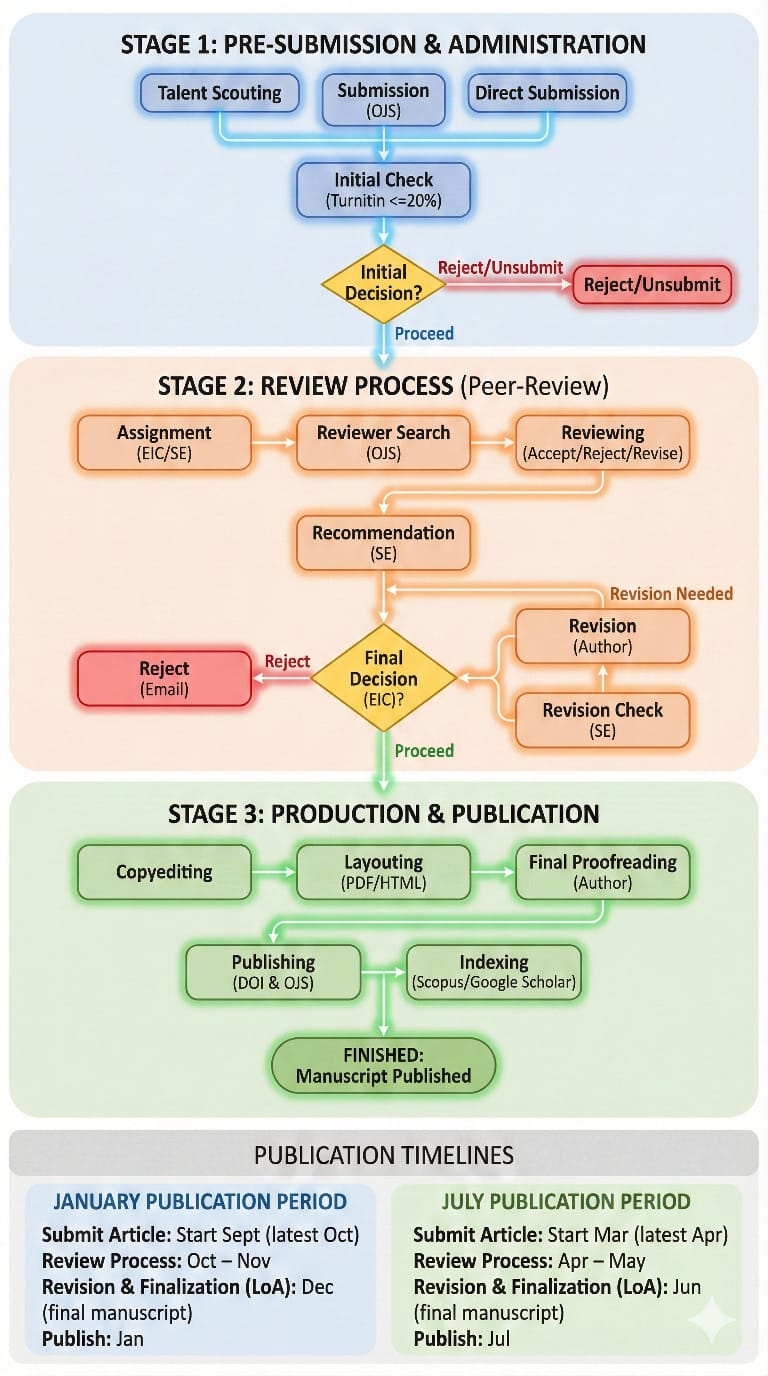
Primary Care Science and Practice (PCSP) follows a rigorous and transparent editorial process to ensure the quality and integrity of published research. The typical workflow from submission to publication is as follows:
Phase 1: Pre-Review Screening
- Submission: Authors submit their manuscripts through the OJS portal.
- Technical & Ethics Check: The Managing Editor conducts an initial screening for formatting, completeness, and a plagiarism check (using Turnitin).
- Desk Review: The Editor-in-Chief or a Section Editor evaluates the manuscript's scientific merit and alignment with the journal’s Focus and Scope. Manuscripts that do not meet the standards are issued a "Desk Rejection".
Phase 2: Peer Review
- Double-Blind Review: Manuscripts that pass the desk review are sent to at least two independent external reviewers. Neither the authors nor the reviewers know each other's identities.
- Reviewer Feedback: Reviewers evaluate the manuscript based on methodology, originality, and clinical relevance.
- Editorial Decision: Based on the reviewers' recommendations, the Editor makes a decision: Accept, Minor Revision, Major Revision, or Reject.
Phase 3: Post-Acceptance & Production
- Copyediting & APC Request: Once accepted, the manuscript undergoes language and stylistic editing. At this stage, authors are requested to complete the Article Processing Charge (APC) payment.
- Layout & Proofing: The manuscript is formatted into the PCSP layout (Galley). Authors are sent a final Galley Proof for approval before publication.
- Publication: A DOI (Digital Object Identifier) is assigned, and the article is published online as Open Access.
Estimated Timeline
- Submission to First Editorial Decision (Desk Review): 1 week.
- Submission to First Reviewer Decision: 4–8 weeks.
- Acceptance to Publication: 2–4 weeks.